



About Cambridge A Level English Language
Cambridge A Level English Language is syllabus 9093. This page works from the syllabus for exams in 2027 and 2028, which is version 1 published September 2024. Exams are available in the June and November series, and also in the March series in India.
An A Level candidate sits four papers. Papers 1 and 2 are the AS Level papers and Papers 3 and 4 are the A Level papers. Candidates following an A Level route are eligible for grades A* to E.
All four papers are worth 25% of the A Level. That is an unusual degree of evenness, and it has a consequence for planning: no paper can be sacrificed.
Paper 1 is Reading. It lasts 2 hours 15 minutes, carries 50 marks, and asks two compulsory questions, Question 1 in Section A and Question 2 in Section B. It is worth 50% of the AS Level and 25% of the A Level.
Paper 2 is Writing. It lasts 2 hours, carries 50 marks, and asks two questions: one compulsory question from Section A and one question from a choice of three in Section B. It is worth 50% of the AS Level and 25% of the A Level.
Paper 2 is the only paper in the qualification that is shorter than the others. Everything else runs to 2 hours 15 minutes.
Paper 3 is Language Analysis. It lasts 2 hours 15 minutes, carries 50 marks, and asks two compulsory questions, Question 1 in Section A and Question 2 in Section B. It is worth 25% of the A Level.
Paper 4 is Language Topics. It lasts 2 hours 15 minutes, carries 50 marks, and asks two compulsory questions each on a separate topic area, Question 1 in Section A and Question 2 in Section B. It is worth 25% of the A Level.
The subject changes character at A Level, and the assessment objectives show it more clearly than any description could. This syllabus has five objectives.
AO1 is to read and demonstrate understanding of a wide variety of texts. AO2 is to write effectively, creatively, accurately and appropriately for a range of audiences and purposes. AO3 is to analyse the ways in which writers and speakers choose form, structure and language to produce meaning and style.
AO4 is to demonstrate understanding of linguistic issues, concepts, methods and approaches. AO5 is to analyse and synthesise language data from a variety of sources.
At AS Level the weightings are AO1 at 15 per cent, AO2 at 45 per cent, AO3 at 40 per cent, and AO4 and AO5 both at zero.
At A Level they are AO1 at 20 per cent, AO2 at 30 per cent, AO3 at 20 per cent, AO4 at 20 per cent and AO5 at 10 per cent.
Read those two lists together. AO4 and AO5 are worth nothing at AS and 30 per cent of the A Level. Writing falls from 45 per cent to 30 per cent. Stylistic analysis falls from 40 per cent to 20 per cent.
So the second year is not more of the first year. It introduces linguistics: concepts, methods, approaches, and the analysis and synthesis of language data. A student who arrives in Year 13 expecting to write more analysis of tone and imagery is preparing for the wrong assessment.
The per-paper breakdown confirms it. Paper 1 is AO1 at 30 per cent, AO2 at 10 per cent and AO3 at 60 per cent. Paper 2 is AO2 at 80 per cent and AO3 at 20 per cent.
Paper 3 is AO1 at 10 per cent, AO2 at 10 per cent, AO4 at 40 per cent and AO5 at 40 per cent. Paper 4 is AO1 at 40 per cent, AO2 at 20 per cent and AO4 at 40 per cent.
Two things follow, and both are worth telling a student plainly. First, Paper 3 is 80 per cent AO4 and AO5: it is a linguistics paper in the strict sense. Second, neither Paper 3 nor Paper 4 assesses AO3 at all, so the stylistic analysis that dominates Paper 1 stops being examined.
The content is four specialised subject areas, and the syllabus names them: language change, child language acquisition, English in the world, and language and the self.
The four areas divide across the two papers. Paper 3 has Section A on language change and Section B on child language acquisition, each worth 25 marks. Paper 4 has Section A on English in the world and Section B on language and the self, each worth 25 marks.
The syllabus also describes what the papers are for. Paper 3 primarily focuses on skills and techniques related to analytical reading, while the emphasis in Paper 4 is on discursive writing. Both papers demand writing, but they are not the same kind of writing.
Paper 3 Section A is the most distinctive question in the qualification. Candidates respond to three texts, not one. The first is a prose text of approximately 300 to 400 words, written at any time from the Early Modern English period, beginning around 1500, to the present day. The other two are sources of language data: an n-gram graph and a word table of corpus data.
Candidates analyse how the prose text exemplifies ways in which English has changed over time, supporting the response with reference to the two data sources and to their wider study. So the answer has to move between a written text, a statistical graph and a corpus table.
The prose text types are listed, and the list is wide: advertisements, brochures, leaflets, editorials, news stories, articles, reviews, blogs, investigative journalism, letters, podcasts, biographies and autobiographies, travel writing, diaries, essays, scripted speech, narrative writing and descriptive writing.
Paper 3 Section B gives candidates a transcript of language spoken by a child or children between the ages of 0 and 8, possibly alongside other speakers. They analyse how the speakers use language, referring to specific details from the transcription and relating their observations to wider study of child language acquisition.
Paper 4 is different in shape. In each of its two questions candidates respond to approximately 400 to 500 words of text on the topic of that section, and then discuss the most important issues the text raises in relation to a specified aspect of that topic, referring to specific details from the text and to wider study.
For Section A that specified aspect is the role and status of the English language in the world. For Section B it is the relationship between language and the self.
Neither A Level paper allows a dictionary. Both state that dictionaries may not be used.
The knowledge the syllabus expects under language change is worth listing because it is more specific than most students expect. It includes the chronology and essential features of the development of English from Early Modern English to Contemporary English, and the terminology of graphology, orthography, phonology, morphology, syntax, lexis, semantics, pragmatics and grammar.
It also names processes: etymology, derivation, inflection, telescoping, coalescence, acronym, conversion, compounding, backformation, blending, borrowing, amelioration, pejoration, broadening and narrowing.
And it names theories: random fluctuation theory, cultural transmission theory, the theory of lexical gaps, substratum theory, functional theory, and tree and wave models.
Under child language acquisition the syllabus expects the stages of early development from 0 to 8 years, the features and functions of spoken language in that period, and a range of relevant theories and theorists.
The syllabus is also clear that the examples given throughout are suggested rather than prescribed, and are not exhaustive. So the lists indicate the depth expected rather than the full content.
There are three routes. Route 1 is AS Level only, taking Papers 1 and 2 in the same exam series. Route 2 is the A Level staged over two years, with Year 1 as the AS Level and Year 2 taking Papers 3 and 4 only. Route 3 is the A Level with all four components in one exam series.
On Route 2, Year 2 is Papers 3 and 4 only, so the AS papers are not retaken. Candidates carry forward their AS Level marks, subject to the rules and time limits described in the Cambridge Handbook.
The qualification is graded A* to E for an A Level candidate. The lower case a to e scale belongs to the AS Level route only.
This page is written for Year 13 students completing the A Level.
Who Cambridge A Level English Language 9093 Is For
This course suits Year 13 students sitting Cambridge A Level English Language 9093 who are strong on textual analysis but have never worked with a corpus table, an n-gram graph or a linguistic theory.
- Year 13 students sitting Papers 3 and 4, or all four papers in one series
- Students who write well but freeze on data and terminology
- Students who have not met language change, child language acquisition, English in the world or language and the self
- Students who describe a transcript instead of analysing it
- Students aiming for linguistics, English, law, journalism or education at university

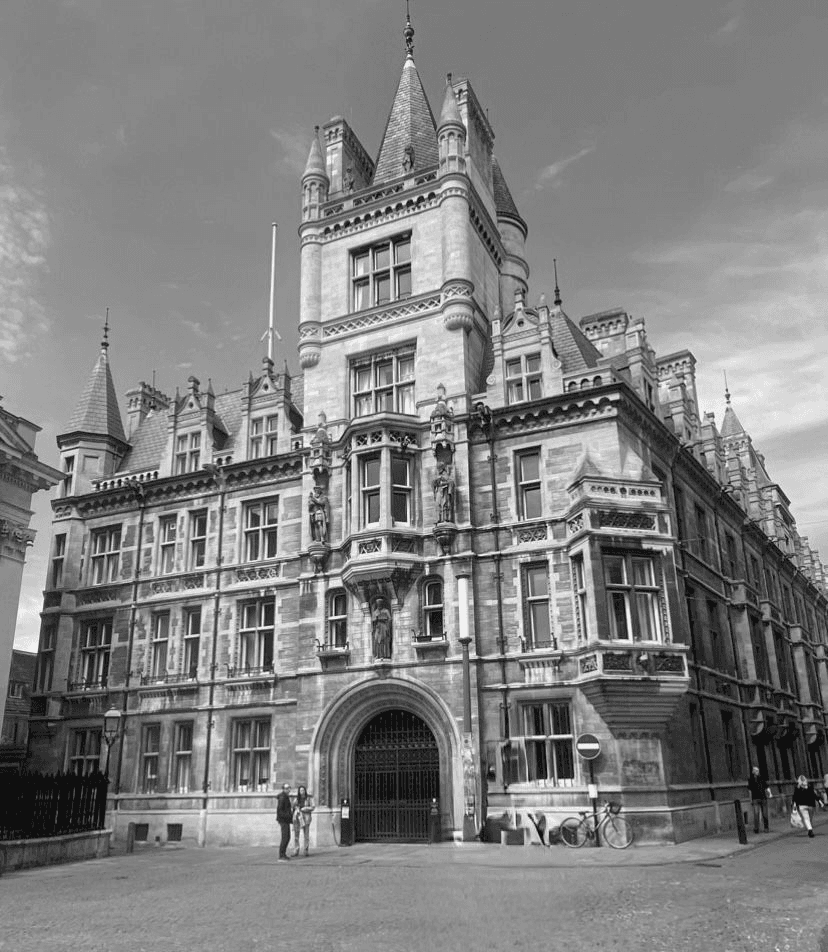

Cambridge A Level English Language: The Board We Cover
Cambridge is the board this page covers. Every fact here comes from Cambridge International's own 9093 syllabus.
Cambridge
Cambridge A Level English Language is syllabus 9093, four papers at 25% each, four specialist topics, and two objectives new at A Level.

How Centaurus Helps Cambridge A Level English Language Students Excel
Language Change
Early Modern English to Contemporary English, with the processes and theories the syllabus names.
Data Sources
n-gram graphs and corpus word tables read as evidence, not as decoration.
Child Language
Transcripts of speech by children from 0 to 8 analysed for features and functions.
Discursive Writing
Paper 4 essays built around a 400 to 500 word text and a specified aspect of the topic.
The New Objectives
AO4 and AO5 are 30 per cent of the A Level and nothing at AS, so they are taught from the first lesson.
24/7 Progress Reporting
Families get access to the Centaurus Academy LMS, with attendance, progress and lesson notes available to parents, students and teachers at any time.



Why Centaurus Stands Out
Choosing the right Cambridge A Level English Language support makes a real difference. Here is how Centaurus Academy compares with typical online providers.

Meet our Team Of Experts
Our expert tutors bring deep subject knowledge and a passion for teaching — helping every student reach their full potential.


What Parents Say About Us

Hear from the parents and students who have experienced our personalised teaching first-hand.
Excellent long-term experience
We have an excellent long-term experience with the academy and Sir Awais. Our three children studied with them during different periods and succeeded well. We highly recommend the academy.
Excellent academy
Centaurus Academy is truly one of the best educational institutions I've come across. The environment is nurturing, the staff are incredibly dedicated, and the quality of education is outstanding. They focus not only on academic excellence but also on character building and personal growth. The teachers are supportive and go the extra mile to ensure every student feels confident and motivated.
My child has gained confidence
I'm very satisfied with the dedication and teaching approach. My child has gained confidence and improved significantly in understanding math concepts, thanks to the teacher's clear explanations and supportive guidance.



Cambridge A Level English Language: Frequently Asked Questions
Explore Tutoring by Country:
Pick your country to see the boards, levels, and subjects our tutors cover near you.




Step Into Your Success
Book a demo lesson today and see how one-on-one tutoring can help your child reach their goals.