

Complete Cambridge IGCSE 2027 Exam Schedule (May/June)
Complete guide to the Cambridge IGCSE 2026 May/June timetable — official dates, registration deadlines, zone schedule, syllabus updates & revision tips.



Table of Contents
- 1. What the May/June 2027 series is
- Who sits this series
- 2. Key dates
- 3. Your zone's timetable
- 4. Dates for the main subjects
- Zone 3
- Zone 4
- Subject codes
- 5. Entry deadlines
- 6. The syllabus that applies
- Biology (0610 / 0970)
- Chemistry (0620 / 0971)
- Physics (0625 / 0972)
- 7. How to revise for it
- Study methods that work
- 8. Common questions
- When do the May/June 2027 exams start?
- When is the deadline to register for June 2027?
- Which countries sit Zone 3?
- Do the 2027 exams use the new syllabus?
- Can private candidates sit IGCSE in June 2027?
- Where do I find my zone's 2027 timetable?
- When are the IGCSE results released?
- 9. Official sources
- More from Centaurus Academy
- Start now
Improve Your Exam Results
Get expert guidance for GCSE, IGCSE, O-Level and A-Level preparation.
Complete Cambridge IGCSE 2027 Exam Schedule
Cambridge has published the final timetable for June 2027. The written exams run from 26 April to 11 June 2027. Below are the dates for each zone, the papers for the main subjects, the entry deadlines, and a revision plan you can start this week.
By Centaurus Academy | Updated: November 2026 | 12 min read
Latest update: the June 2027 timetable is final and public. Entry deadlines for June 2027 are still being confirmed by Cambridge, so check the official page before you rely on any date.
On this page
- What the May/June 2027 series is
- Key dates
- Your zone's timetable
- Dates for the main subjects
- Entry deadlines
- The syllabus that applies
- How to revise for it
- Common questions
- Official sources
1. What the May/June 2027 series is
The May/June series is the largest exam window in the Cambridge year. Most IGCSE students sit their exams in it. Cambridge runs two other series, one in February/March and one in October/November, and many students use those for retakes.
Cambridge puts every school into one of six zones, and runs a separate timetable for the UK. Your zone decides which day you sit each paper and whether it starts in the morning or the afternoon. The subject content and the marking are the same in every zone.
More than 70 IGCSE subjects are available. That adds up to hundreds of papers spread across seven weeks, so the timetable is long and it is easy to misread. Always work from your own zone's PDF, not from a friend's.
If you want help with a subject, our IGCSE tutors teach the same Cambridge specification your school enters you for.
Who sits this series
Most full-time students in international schools. It is also the main window for private candidates. Your school decides which series you sit, so confirm with your exams officer rather than assuming.
2. Key dates
- Written exams open: 26 April 2027
- Written exams close: 11 June 2027
- Week 1: 26-30 April
- Week 2: 03-07 May
- Week 3: 10-14 May
- Week 4: 18-21 May
- Week 5: 24-28 May
- Week 6: 31 May - 04 June
- Week 7: 07-11 June
- Speaking and practical tests: from March 2027, subject by subject
- IGCSE results: mid-August 2027
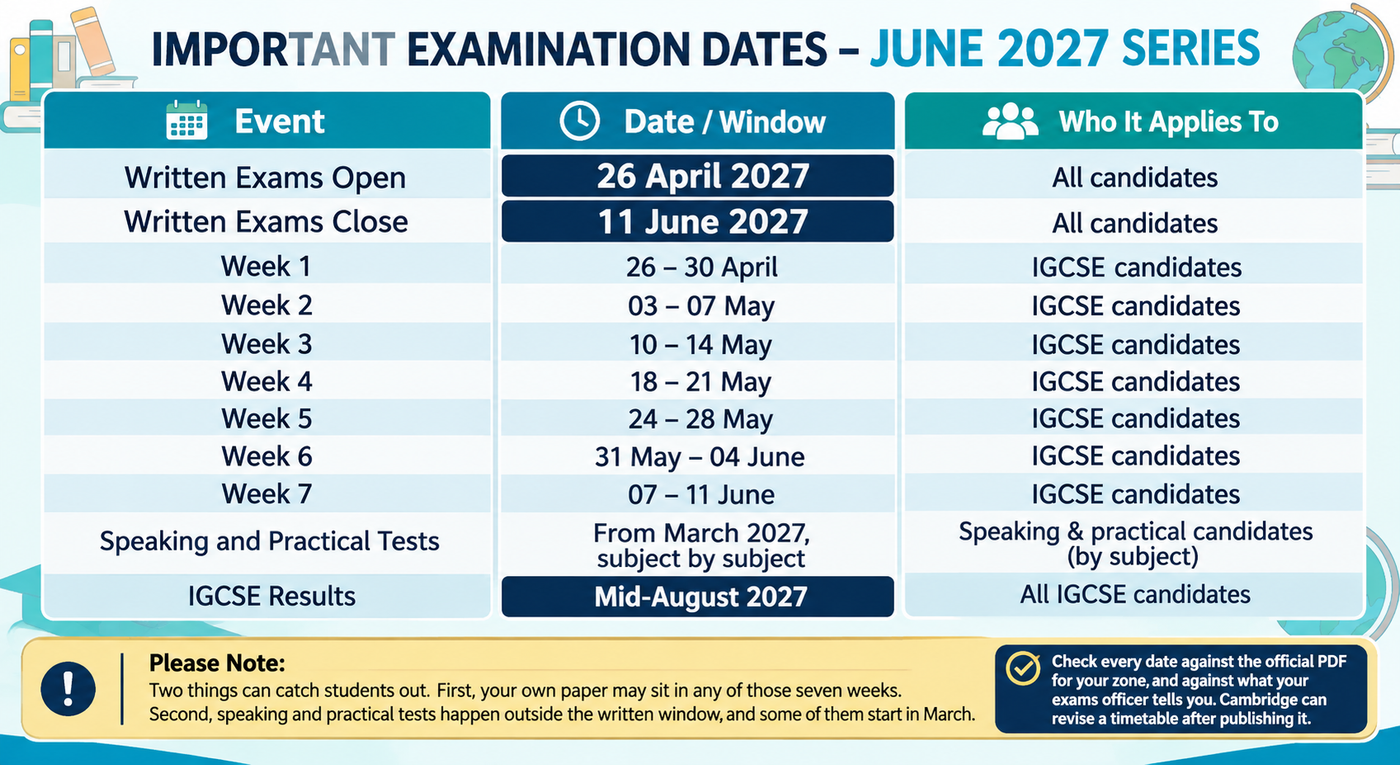
Two things catch students out. First, your own paper may sit in any of those seven weeks. Second, speaking and practical tests happen outside the written window, and some of them start in March.
Check every date against the official PDF for your zone, and against what your exams officer tells you. Cambridge can revise a timetable after publishing it.
3. Your zone's timetable
- Zone 1: USA, Canada, the Caribbean, Latin America
- Zone 2: Sub-Saharan and West Africa
- Zone 3: Egypt, Kuwait, Qatar, Saudi Arabia, Iraq, Jordan, Bahrain, Syria, Lebanon, Tunisia, Sudan, Libya
- Zone 4: UAE (most centres), Pakistan, Bangladesh, Sri Lanka
- Zone 5: Singapore, Malaysia, Hong Kong, China, Thailand
- Zone 6: Australia, New Zealand, the Pacific
- UK: United Kingdom, on its own timetable
Download the PDF for your zone:
- Zone 1 timetable
- Zone 2 timetable
- Zone 3 timetable
- Zone 4 timetable
- Zone 5 timetable
- Zone 6 timetable
- UK timetable
If your school is in Pakistan or Bangladesh, it most likely sits Zone 4. A few international schools register under a different zone, so ask your exams officer to confirm yours before you plan anything.
4. Dates for the main subjects
These come from the official June 2027 timetables. Core and Extended candidates often sit different papers on different days, so match your own paper code.
Zone 3
- Biology (0610) /31, /41: Mon 26 April 2027, PM
- Biology (0610) /51, /61: Tue 11 May 2027, PM
- Biology (0610) /11, /21: Tue 08 June 2027, PM
- Chemistry (0620) /31, /41: Tue 27 April 2027, PM
- Chemistry (0620) /51, /61: Thu 13 May 2027, PM
- Chemistry (0620) /11, /21: Thu 10 June 2027, PM
- Physics (0625) /31, /41: Fri 07 May 2027, PM
- Physics (0625) /51, /61: Tue 25 May 2027, PM
- Physics (0625) /11, /21: Wed 09 June 2027, PM
- Mathematics (0580) /12, /22: Wed 28 April 2027, AM
- Mathematics (0580) /32, /42: Wed 05 May 2027, AM
- English First Language (0500) /11: Thu 29 April 2027, PM
- English First Language (0500) /21: Tue 04 May 2027, PM
- English Second Language (0510) /11: Thu 29 April 2027, PM
- English Second Language (0510) /21: Mon 24 May 2027, PM
Zone 4
- Biology (0610) /32, /42: Mon 26 April 2027, AM
- Biology (0610) /52, /62: Tue 11 May 2027, AM
- Biology (0610) /12, /22: Tue 08 June 2027, AM
- Chemistry (0620) /32, /42: Tue 27 April 2027, AM
- Chemistry (0620) /52, /62: Thu 13 May 2027, AM
- Chemistry (0620) /12, /22: Thu 10 June 2027, AM
- Physics (0625) /32, /42: Fri 07 May 2027, AM
- Physics (0625) /52, /62: Tue 25 May 2027, AM
- Physics (0625) /12, /22: Wed 02 June 2027, AM
- Mathematics (0580) /12, /22: Wed 28 April 2027, PM
- Mathematics (0580) /32, /42: Wed 05 May 2027, PM
- English First Language (0500) /12: Thu 29 April 2027, AM
- English First Language (0500) /22: Fri 14 May 2027, AM
- English Second Language (0510) /12: Thu 29 April 2027, AM
- English Second Language (0510) /22: Mon 24 May 2027, AM
The same subject can fall in a different week in a different zone. Biology Paper 4 is 26 April in both zones above, but the session differs, and Physics Paper 6 lands on 09 June in Zone 3 and 02 June in Zone 4. This is why the zone PDF matters more than any summary.
Subject codes
- Mathematics: 0580 / 0980
- Biology: 0610 / 0970
- Chemistry: 0620 / 0971
- Physics: 0625 / 0972
- English Language: 0500 / 0990
- Computer Science: 0478 / 0984
- Economics: 0455 / 0987
- Business Studies: 0450 / 0986
For subject pages on the Cambridge board, see our Cambridge IGCSE subjects. For practice material, see IGCSE past papers.
5. Entry deadlines
Cambridge splits entry into two deadlines for the June series. Both run through your school, not through Cambridge directly.
- February: deadline to register for the June exam series
- April: deadline for late entries for the June exam series
Contact your school's Cambridge exams officer to register, and contact them again if you miss the February date so they can check whether a late entry is still possible. Late entries cost more.
Your school will also set its own cut-off, and that date comes before Cambridge's. It is the one that applies to you, so ask for it now rather than in April.
If you are a private candidate, you have to register through an approved Cambridge centre. Cambridge does not take entries from private candidates directly.
Two practical points. Entry codes have to match the papers you actually plan to sit, because a wrong option code can put you in for the wrong tier. And once the late window closes, there is no further entry for that series.
Official source: Cambridge dates and deadlines
6. The syllabus that applies
The 2026-2028 syllabuses cover the 2027 exams. If you started preparing this year, nothing you have learned has gone out of date.
Biology (0610 / 0970)
The paper tests three assessment objectives. Knowledge carries 50%, handling information and problem solving carries 30%, and experimental skills carry 20%. Topics that come up often in examiner reports include ecology, reproduction, transport in plants and humans, and nutrition.
Chemistry (0620 / 0971)
Twelve core topics stay in place. On the Extended route, Paper 4 counts for 50%, Paper 6 for 30% and Paper 2 for 20%. Theory work carries the most marks, so give it the most time. Organic chemistry, acids and bases, bonding, metals, rates and equilibrium appear most often.
Physics (0625 / 0972)
Mechanics, electricity, waves and nuclear physics still carry the heavy data-handling questions. Paper 6 asks you to plan and analyse, so practise reading unfamiliar experiments rather than memorising set ones.
Revise from the current 2026-2028 syllabus PDF. Notes from 2023 or earlier still cover topics that have been removed.
7. How to revise for it
Work backwards from your own exam dates. Build the plan around those dates, not around the calendar.
Phase 1, now to March 2027. Finish the content. Keep notes short and tied to the syllabus. Test yourself daily: close the notes, then write down what you remember. Use flashcards for definitions. Start with the subject that has your earliest paper.
Phase 2, March to April 2027. Move to past papers. Use 2019 to 2022 papers first, because they build the habit of answering in the style the mark scheme wants. Mark your work against the official scheme and keep an error log. Write down whether each mistake was a gap in knowledge, a method error or a timing problem.
Phase 3, April to May 2027. Switch to the most recent papers, including 2023 onwards. These match the current syllabus and the language examiners use now.
Phase 4, the last two weeks before each paper. Sit full papers under exam conditions. No notes, no pauses. Aim to finish ten minutes early so you can check units, significant figures and equations. Do not start new topics in the final week.
Study methods that work
- Testing yourself: answer questions from memory, then check. Strong evidence.
- Spacing: revisit a topic after 1, 3, 7 and 14 days. Strong evidence.
- Mixing subjects: do Biology, then Chemistry, then Physics in one session. Moderate to strong.
- Explaining causes: ask why and how for every fact. Moderate.
- Timed papers with marking: mark strictly, log errors, retest after 48 to 72 hours. Strong.
Command words carry marks. State, describe, explain, compare and evaluate each need a different kind of answer, and a good answer to the wrong command word scores little. Learn them before your first paper.
Our IGCSE programmes build these methods into a weekly plan tied to your own timetable.
8. Common questions
When do the May/June 2027 exams start?
Written papers start on 26 April 2027 and finish on 11 June 2027. Speaking and practical tests can start in March, depending on the subject.
When is the deadline to register for June 2027?
February is the registration deadline for the June series. April is the deadline for late entries. Your school sets an earlier internal cut-off, so ask your exams officer for that date and use it.
Which countries sit Zone 3?
Zone 3 covers Egypt, Kuwait, Qatar, Saudi Arabia, Yemen, Palestine, Iraq, Jordan, Bahrain, Syria, Lebanon, Tunisia, Sudan and Libya. Some UAE centres sit Zone 3, others Zone 4, so confirm with your school.
Do the 2027 exams use the new syllabus?
Yes. The 2026-2028 syllabuses apply to the 2027 exams, and they are the same ones used in 2026. Material written for the current specification is still correct.
Can private candidates sit IGCSE in June 2027?
Yes, through an approved Cambridge centre. Cambridge does not take direct entries from private candidates. Contact the centre early, because places are limited.
Where do I find my zone's 2027 timetable?
All six zone PDFs and the UK timetable are on the Cambridge exam timetables page. The links are in section 3 above. Check that the paper codes in the PDF match the codes you are entered for.
When are the IGCSE results released?
Mid-August 2027. AS and A Level results come earlier, in late July 2027. Your school tells you the exact day and how to collect.
9. Official sources
- Cambridge exam timetables: the final PDF for each zone
- Cambridge dates and deadlines: entry deadlines and results dates
- Cambridge guide to making entries: entry process, fees and availability
- Cambridge IGCSE syllabuses 2026-2028: current syllabus PDFs
- Save My Exams IGCSE resources: topic notes and past-paper questions
More from Centaurus Academy
- IGCSE tutoring and academic programmes
- Cambridge board, subjects and levels
- IGCSE past papers and mark schemes
- Mathematics, Biology, Chemistry, Physics
- Plan your IGCSE 2027 revision
Start now
Your first paper may be in April 2027. The work you do this term sets what is possible in the exam hall.
If you would rather cover a subject start to finish on video, the IGCSE video courses follow the same Cambridge, Edexcel and AQA specifications, with solved past papers and topic tests for each topic.
This guide is information, not official advice. Check every date against Cambridge's own publications and your exam centre. Cambridge can change a timetable after publishing it. Centaurus Academy is an independent education provider and is not affiliated with Cambridge Assessment International Education.